 DriveFinch
Kansas DMV Practice Test 2026
25 free questions for the Kansas written permit test. Choose an answer to see right away whether it is correct and why. No sign-up.
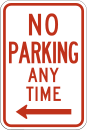
What does this sign tell drivers about parking at this location?
All 25 questions with answers
Open a question to see the correct answer and the explanation.
What does this sign tell drivers about parking at this location?
- Parking is never allowed there, at any time of day
- Parking is allowed only overnight
- Parking is allowed there for up to two hours at a time
- Parking is allowed only on weekends
Correct answer: Parking is never allowed there, at any time of day. This sign prohibits parking at that location at all times, with no exceptions for time of day.
Source: MUTCD 2009 Sec. 2B.46
At a four-way stop, which vehicle should proceed through the intersection first?
- The vehicle that stopped first
- The vehicle turning left at the intersection
- The vehicle positioned on the left
- Whichever vehicle is the largest in size
Correct answer: The vehicle that stopped first. Vehicles at an all-way stop proceed in the order they arrived; the first vehicle to stop is the first to go.
Source: Florida Driver Handbook, PDF p.55, All Way Stop
Why is parking in front of a private driveway generally illegal?
- It has no real effect on anyone nearby.
- It can block the owner from entering or leaving.
- It is only illegal on weekends and holidays.
- It's allowed as long as you leave a short note behind.
Correct answer: It can block the owner from entering or leaving.. Blocking a private driveway can trap the property owner's vehicle inside or keep them from pulling in, which is why it's treated as illegal parking.
Source: California Driver Handbook, Parking-Illegal Parking p.68-77
In Kansas, what is the minimum age to be issued a provisional (restricted) driver's license after holding a learner's permit for the required time?
- 15 years old
- 14 years old
- 15.5 years old
- 16 years old
Correct answer: 15 years old. After meeting the permit-holding period and other requirements, a young driver in Kansas can be issued a provisional license at 15 years old.
What should you expect on the road after seeing this sign?
- A traffic signal is ahead, which may be hidden by a curve or hill
- The paved shoulder ahead is being used as an extra travel lane
- A YIELD sign is ahead
- A STOP sign is ahead, even if you cannot see it yet
Correct answer: A STOP sign is ahead, even if you cannot see it yet. Seeing this sign means a STOP sign is ahead, even if you cannot see it yet. Drivers should reduce speed and stay alert for this condition.
Source: MUTCD 2009 Sec. 2C (Warning Signs)
A 16-year-old with a provisional license in Kansas is planning to drive home from a friend's house late at night. Under the GDL nighttime restriction, what time must they generally be off the road by (absent an exception like work or school)?
- 8:00 p.m.
- 11:00 p.m.
- 9:00 p.m.
- 12:00 a.m.
Correct answer: 9:00 p.m.. Without a qualifying exception, a restricted teen driver in Kansas must generally stop driving by 9:00 p.m..
Why do highway authorities create HOV (carpool) lanes on congested highways?
- To provide extra parking during rush hour traffic.
- To encourage carpooling and cut vehicle numbers.
- To keep trucks separated from passenger cars.
- To create a lane used only by emergency crews.
Correct answer: To encourage carpooling and cut vehicle numbers.. HOV lanes reward vehicles carrying multiple occupants with a faster lane, which encourages carpooling and helps reduce the total number of vehicles on congested roads.
Source: California Driver Handbook, Lane Control-Carpool/HOV Lanes p.58
A 16-year-old with a Kansas Lesser Restricted License wants to drive at 10 p.m. What must be true for this to be allowed?
- Nothing at all, the nighttime curfew simply never applies to a 16-year-old driver
- One of the recognized exceptions (school, work, religious activity, licensed adult) must apply
- They must pay a special night-driving fee to the county treasurer's office
- They must be accompanied by any sibling, regardless of that sibling's own age
Correct answer: One of the recognized exceptions (school, work, religious activity, licensed adult) must apply. Outside the 5 a.m.-9 p.m. window, a 16-year-old Lesser Restricted License holder may only drive under one of Kansas's recognized exceptions.
Source: Kansas Driver Handbook, Driving Restrictions 14-15/16-17 Year Old's
Who besides the driver and the supervising adult may occupy the front seat during Instruction Permit practice in Kansas?
- A licensed sibling
- A driving instructor's assistant
- No one else
- Any adult passenger
Correct answer: No one else. Kansas allows no one else in the front seat besides the driver and the supervising adult.
Source: Kansas Driver Handbook, Instructional Permit Class C or M
Which of these matches the following-distance guideline given in the Kansas handbook for normal conditions?
- 2 seconds
- 9 seconds
- 1 second
- 6 seconds
Correct answer: 2 seconds. Kansas teaches a minimum following gap of 2 seconds in good conditions, measured using a fixed roadside point.
In Kansas, when can a driver legally turn left on a red light?
- Left turns on red are never allowed under any circumstances
- Only when you turn onto a one-way street from a two-way street
- Only when turning from a one-way street onto another one-way street, after stopping
- Only during daytime hours
Correct answer: Only when turning from a one-way street onto another one-way street, after stopping. A left turn on red is a narrow exception in Kansas: it only applies where both the street you're on and the street you're entering are one-way, and only after a full stop and yielding right-of-way.
What does this green sign with a bicycle symbol mark?
- A road segment where bicycles are completely banned
- A pedestrian-only path
- A designated route for bicyclists
- A route reserved for buses
Correct answer: A designated route for bicyclists. This sign marks a route that has been designated for bicycle travel, helping cyclists follow a planned path.
Source: MUTCD 2009 Part 2D
Which direction of traffic does Kansas's move-over law apply to?
- Only oncoming traffic
- Both directions equally, regardless of any divider
- Traffic traveling in the same direction as the stopped vehicle
- Only traffic on interstate highways
Correct answer: Traffic traveling in the same direction as the stopped vehicle. The move-over duty in Kansas applies to drivers traveling in the same direction as the stopped emergency vehicle.
Source: Kansas Driver Handbook, Move-Over Laws
On a two-way road, the line on your side of the center is broken (dashed) yellow, while the line on the oncoming traffic's side is solid yellow. What does this mean for you?
- You may pass when safe; the oncoming driver may not
- Neither driver may pass in this situation at all
- Both drivers may pass whenever they choose to do so
- Only the oncoming driver is allowed to pass here
Correct answer: You may pass when safe; the oncoming driver may not. Each side of a two-way center line is read separately: a broken line permits passing on that side when safe, while a solid line on the other side means those drivers may not pass.
Source: California Driver Handbook, PDF p.41, broken yellow line: may pass if movement can be made safely
Unless otherwise posted, what is the maximum speed in a properly marked Kansas school zone or business district?
- 30 mph
- 20 mph
- 35 mph
- 15 mph
Correct answer: 20 mph. Kansas sets a default 20 mph maximum for both properly marked school zones and business districts.
Source: Kansas Driver Handbook, Speed Limits
At an intersection with no traffic signal, a pedestrian is waiting to cross in a crosswalk that has no painted lines. What must the driver do?
- Yield to the pedestrian just as in a marked crosswalk
- Only slow down, since there are no painted lines
- Proceed if the pedestrian has not stepped off the curb yet
- Only yield if a police officer is directing traffic
Correct answer: Yield to the pedestrian just as in a marked crosswalk. Drivers must yield to pedestrians in any crosswalk, whether it is marked with painted lines or not; an unmarked crosswalk still legally exists at most intersections.
Source: California Driver Handbook, PDF p.36, yield to pedestrians within any crosswalk, marked or unmarked
Approximately how long does the Kansas knowledge test usually take, even though it is not timed?
- 5 minutes
- 45 minutes to an hour
- 15 to 20 minutes
- 2 hours
Correct answer: 15 to 20 minutes. Although untimed, the Kansas knowledge test generally takes about 15 to 20 minutes to finish.
Source: Kansas Driver Handbook, Required Noncommercial License Tests
If an oncoming driver fails to dim their high-beam headlights and you are temporarily blinded by the glare, what is the safest response?
- Flash your own high beams repeatedly and stare directly at their headlights
- Look toward the right edge of the road or lane markings, and slow down if needed
- Close your eyes briefly
- Speed up to pass the glare quickly
Correct answer: Look toward the right edge of the road or lane markings, and slow down if needed. Looking directly at oncoming high beams temporarily ruins your night vision. Instead, look toward the right edge of the roadway or the lane markings to keep your bearings, and slow down if you need more time to react.
Source: California Driver Handbook, Driving Hazards-Driving in Darkness, p.99 (2020 handbook PDF)
A steady red "X" displayed above a lane on the highway means what?
- Do not drive in that lane
- That lane is for buses only
- Merge into that lane immediately
- That lane is for left turns only
Correct answer: Do not drive in that lane. A red X above a lane means that lane is closed; you must not drive in it.
Source: Florida Driver Handbook, PDF p.60, Red X: never drive in a lane under the red X
What is the minimum age for a Kansas Farm Permit?
- 14
- 15
- 16
- 17
Correct answer: 14. Kansas sets the Farm Permit's minimum age at 14, the same starting point as the standard Instruction Permit.
Source: Kansas Driver Handbook, Types of Driver's Licenses and Driver's Permits (Farm Permit)
What should you expect on the road after seeing this sign?
- Vehicles entering from a side road ahead will merge directly into your lane
- The lane you are in ends ahead and you must move into another lane
- The lane shown on the sign (right or left) ends ahead
- A new lane is being added to the roadway ahead, so merging is not required
Correct answer: A new lane is being added to the roadway ahead, so merging is not required. Seeing this sign means a new lane is being added to the roadway ahead, so merging is not required. Drivers should reduce speed and stay alert for this condition.
Source: MUTCD 2009 Sec. 2C (Warning Signs)
If the DON'T WALK signal (or raised hand) starts flashing while you are already partway across the street, what should you do?
- Stop immediately right in the middle of the road
- Turn back to the curb you started from
- Continue and finish crossing to the other side
- Sit down and wait for the next WALK signal
Correct answer: Continue and finish crossing to the other side. If the signal starts flashing after you have already begun crossing, keep going and finish crossing safely; do not start a new crossing, and do not stop in the road.
Source: California Driver Handbook, PDF p.42, if the signal begins blinking, you may continue across the street
What does a posted speed limit sign represent?
- The maximum legal speed under ideal conditions — not necessarily a safe speed in every situation
- The speed you must always drive at, no matter what the weather or traffic looks like
- The minimum speed you must maintain on every road at all times, even in a storm
- A suggestion posted by the city that drivers are free to ignore whenever they want
Correct answer: The maximum legal speed under ideal conditions — not necessarily a safe speed in every situation. A speed limit sign shows the highest speed allowed when conditions are good; rain, fog, heavy traffic, or poor visibility can make that speed unsafe.
Source: Florida Driver Handbook, Glossary-Basic Speed Law
What is the minimum age and experience required of the adult supervising a Kansas Instruction Permit holder?
- At least 21 years old with at least one year of driving experience
- At least 18 years old with a currently valid license
- At least 25 years old with a completely clean record
- Any licensed driver of any age, with no experience needed
Correct answer: At least 21 years old with at least one year of driving experience. Kansas requires the supervising adult to be at least 21 years old with at least one year of driving experience.
Source: Kansas Driver Handbook, Instructional Permit Class C or M
When is passing another vehicle usually prohibited by a pavement marking?
- When there is a broken white line on your side
- When you are on a two-lane road with any yellow line
- Pavement markings never restrict your ability to pass
- When there is a solid yellow line on your side
Correct answer: When there is a solid yellow line on your side. If the yellow center line on your side is solid, you are in a no-passing zone. A broken line on your side means you may pass when it is safe.
Source: Texas Driver Handbook, Ch5 Pavement Markings p.33 (solid yellow = no-passing zone)
Kansas permit test: common questions
How many questions are on the Kansas permit test?
25 questions, pass with 20 correct.
Are these the real Kansas test questions?
No. They are practice questions that cover the same topics: traffic laws, road signs and safe driving. The real test is set by Kansas Department of Revenue, Division of Vehicles.
Is this practice test free?
Yes. There is nothing to sign up for. The DriveFinch app has the full question bank, works offline and is free (one small banner ad).
Practice tests for other states
- Alabama
- Alaska
- Arizona
- Arkansas
- California
- Colorado
- Connecticut
- Delaware
- District of Columbia
- Florida
- Georgia
- Hawaii
- Idaho
- Illinois
- Indiana
- Iowa
- Kentucky
- Louisiana
- Maine
- Maryland
- Massachusetts
- Michigan
- Minnesota
- Mississippi
- Missouri
- Montana
- Nebraska
- Nevada
- New Hampshire
- New Jersey
- New Mexico
- New York
- North Carolina
- North Dakota
- Ohio
- Oklahoma
- Oregon
- Pennsylvania
- Rhode Island
- South Carolina
- South Dakota
- Tennessee
- Texas
- Utah
- Vermont
- Virginia
- Washington
- West Virginia
- Wisconsin
- Wyoming